Late season fishing days.

As autumn wanes, and winter seeks to take hold,  sometimes the weather smiles on the fortunate angler, allowing just one more trip before the season closes.

A recent Saturday delivered one such day, where there was enough sun to warm the still air, giving hope of a late hatch.  I had to head up to the mountains to run a couple of errands. If I finished early I’d have the chance for a few peaceful hours on the water, so the rod went in the back of the car too.

By 12:30pm , my business was finished, so I decided to drop in to the river nearby,  at a public access point that I had always driven past but never fished.  On arrival, I was disappointed to see a truck parked up. My suspicions of another angler were confirmed by the fish ruler resting on the back seat.

With no clues as to the type of angler – spin, bait or fly  – and that I really didn’t have time to look for another spot, I shrugged my shoulders, and grumbling, I lowered my expectations.  I consoled myself with the thought that I’d be exploring new water at least, and it would be good research for the next season, if as I feared , I was following another angler upstream.

Down by the water, I strung my rod, with dry and bead head dropper and drifted it through the first run. It was a nice stretch, but undoubtedly well fished, so I wasn’t surprised that the flies remained untroubled after each pass.  It was nice to be on the water on such a glorious day – we anglers tell ourselves this, but really it is always a better day if the fish cooperate. I was hoping they would.

Just above the run was a long slow pool, I stood and watched for a few minutes, a small dimple soon gave away the position of a sipper quietly working the bubble line.  Wish granted. With a wall of tree’s behind I could only roll cast, and I was able roll a few my small Royal Wulff combo out for a few well-directed casts before …  nothing.  I decided to swap to a natural brown nymph and a parachute emerger then watched and waited.  No more rises. I had put my finny friend down. My presentations had not been the most delicate;  leaving on the small bead head had been a mistake. I moved on.

In the next stretch, the emerger was followed by a small dark shape which nosed it roughly a few times before sucking it down.  My lift was poorly timed… . I spooked that one too!  0 – 2 !  At least the trout were willing, even if the angler a little clumsy.

Time to concentrate. I continued up-stream fishing the likely spots.  Soon enough he emerger vanished as a small rainbow tugged the nymph from below. It was my first drift through in a small side branch. A cast or two later I returned a brightly spotted brown trout, its twin in size, to the same run. I spent the next hour working from pool to pool, landing a handful of emerald spotted fellows. All of whom found the small brown nymph much to their liking.

I spotted an angler approaching from upstream.  I checked my watch knowing I had made my last cast ; it was nearly time to head back to the car, so I could be home at the allotted hour (before dark). I wound in and hailed him, and we compared notes as we made our way back down stream together.  Earlier in the day, in the faster sunny stretch he had good success on a Royal Wulff and bead-head,  yet he had no luck at all fishing ahead of me with the same flies.  At this time of year in the quieter water the trout are often more selective, and I can’t say for sure, but perhaps that is why the river gave up a half-dozen sprightly fellows to my natural nymph.

As I sit here, reflecting on what I suspect was the ultimate outing for this fantastic season, my thoughts are already turning to opening day in September.  So whilst the waders and flies are being put away for the winter months, the rods and lines will not. I will be preparing for next season, working on casting skills for the coming season.


.


Autumn Challenges

As I watched the third bow wave for the morning disappear at the heavy tread of a wading boot behind me, I had to remember I was fishing with a beginner. . My companion for the day was more used to heel-first striding along the footpath in the urban landscape, and blissfully unaware of the noise he was making and the impact he was having. They are common mistakes we all make at times, that cost us the opportunity to catch our prey.

Moving on, I suggested that he should wait, and I would advance to the next pool and see if I could spot a fish. After a few minutes he should sneak up and join me. I tip-toed to the next pool, keeping low and against the bush, and watched a few moments before I found a tail waving gently over the gravel. (A tell tail sign perhaps?). I had been watching quietly for a few minutes, and was about to turn, when a quiet voice beside me asked, “Can you see anything?”. Nice sneaking I thought and replied, “Yep, don’t move! There is one in the middle”. “Just there” he said, as his arm sprang to point it out. Unsurprisingly our finny friend departed in a hurry at this too-sudden movement. Another lesson learned.

At the next stretch, we stood well back, and I pointed out the likely lie, and suggested a sneaky approach that would put him into casting distance. He slipped into position, taking his time, and dropped his fly onto the quiet water. It had barely drifted a foot before it was sipped down. A strike and a shout of joy, and we soon had it in the net. The highlight of a great day on the water, with new lessons for him, and good reminders for me.

Autumn stalking:

After a great summer, where a few weeks ago, the trout that were so focused on hoovering hoppers hard against the grassy banks and you could almost wade right up to them, it is easy to forget that autumn is a testing time, even for the stealthy angler. The trout are to be found in the quiet pools, supping on errant nymphs, or sipping on the trickle of duns that occasionally hatch in the still cool air of autumn air.

In summer, trout often sit the faster water, and it is easy to get close to them; movement is masked by the rough surface of such water, sound and pressure waves are muffled by the faster moving water, but in autumn stealth is mandatory.  Low clear water give the trout the upper hand.  They are afforded an excellent view of their surrounds, and are sensitive to any vibration or pressure wave that carries easily through the super-still water.

The following advice is not new, and is there in nearly every trout fishing book I have read. But we often neglect to heed it:

  • Tread lightly,
  • Avoid wading,
  • Move slowly, and keep a low profile.

Tread Lightly. I like to tip-toe along, walking on the balls of my feet, feeling for the ground, and letting the rest of my foot slowly descend till my foot is firmly on the ground.  You can practice at home with barefoot, sneaking around from room to room, although this may get you in trouble.  At one time I was practising this so much, it became a habit, people would accuse me of sneaking up on them!

Avoid Wading. On small streams, this is good advice at all times, as fish are sensitive to noises, vibrations and pressure waves. If you have to wade, stay out of the still slow water, fish from the faster water just below the tail of the pool. The advice from another author is to wade like a heron, given the disparate thickness of my legs and those of a heron, I could never make any sense of this. Perhaps the author himself had chicken legs. I suggest moving slowly as if walking through honey, almost slow motion, if you are making a bow wave or you create pressure waves your pace is too fast. Pressure waves will always lead you up the pool, and any trout will be long gone before you or your fly arrives.

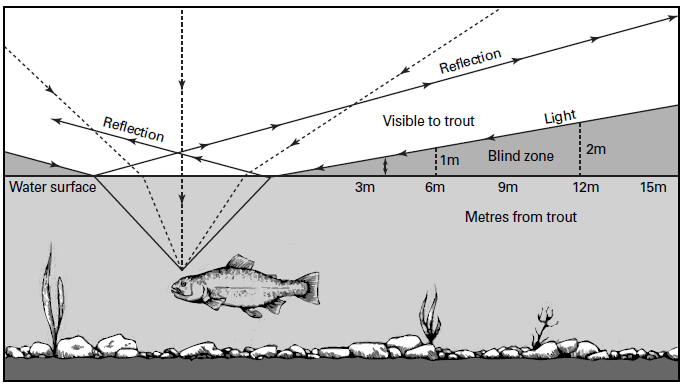
Move slowly, keep a low profile. Trout are attuned to fast moving dangers from above (think birds of prey!), so will spook easily at fast movement, especially when silhouetted against a sky. Due to the physics of light bending at water surface, trout can see you quite easily. Check out the diagram below that I found on the net.

cone-of-vision

You can see, on level ground, that an average person can get within 10m without being seen, crouch down and you can get within 5 m or closer, especially if you have bush behind you and you are wearing drab clothes.

Enjoy the Autumn.  Light feet and tight Lines !

Hopper Fishing

February and March is one of my favourite times to fish in the meadow streams.  The hoppers are about, and they are a juicy high energy meal for a trout.  The trout hang close to the grassy banks an overhangs, waiting for the wind to blow a wayward hopper on to the water.

It is a dry fly fisher’s fantasy. The fish are looking up and a hopper plopping on the water is like the ringing of the dinner bell.  The trout slips quietly out from under the dark under cut, noses up under the struggling Orthoptera.

It is a great time for beginners and experts alike to be on the water. For the beginner it offers exciting visual fishing with plenty of opportunities to try to hook a trout.  Not too much finesse is needed with the presentation, in fact it is better to plop the fly down hard. For the expert, there is a chance to bag a big one, as the larger trout, usually more circumspect by day, are willing participants in the sport when hoppers are about.  To fool a trophy, demands accurate casts within inches of the bank, or under an undercut.

However it is only the most natural drift that will fool the wily older ones, so you need to get a drag free drift.  Many missed hookups, and refusals are as a result of drag, or micro drag, where the fly slips across the surface, instead of eddying and drifting with the micro-currents.

Hoppers come in many sizes and colours, it is good to have a few different patterns in your box, so you can match size and colour. I like simple foam hoppers in tan or green, with some rubber legs.

Sadly hopper fishing is fast coming to an end as I write this post, but soon the Autumn may fly hatches will begin.